
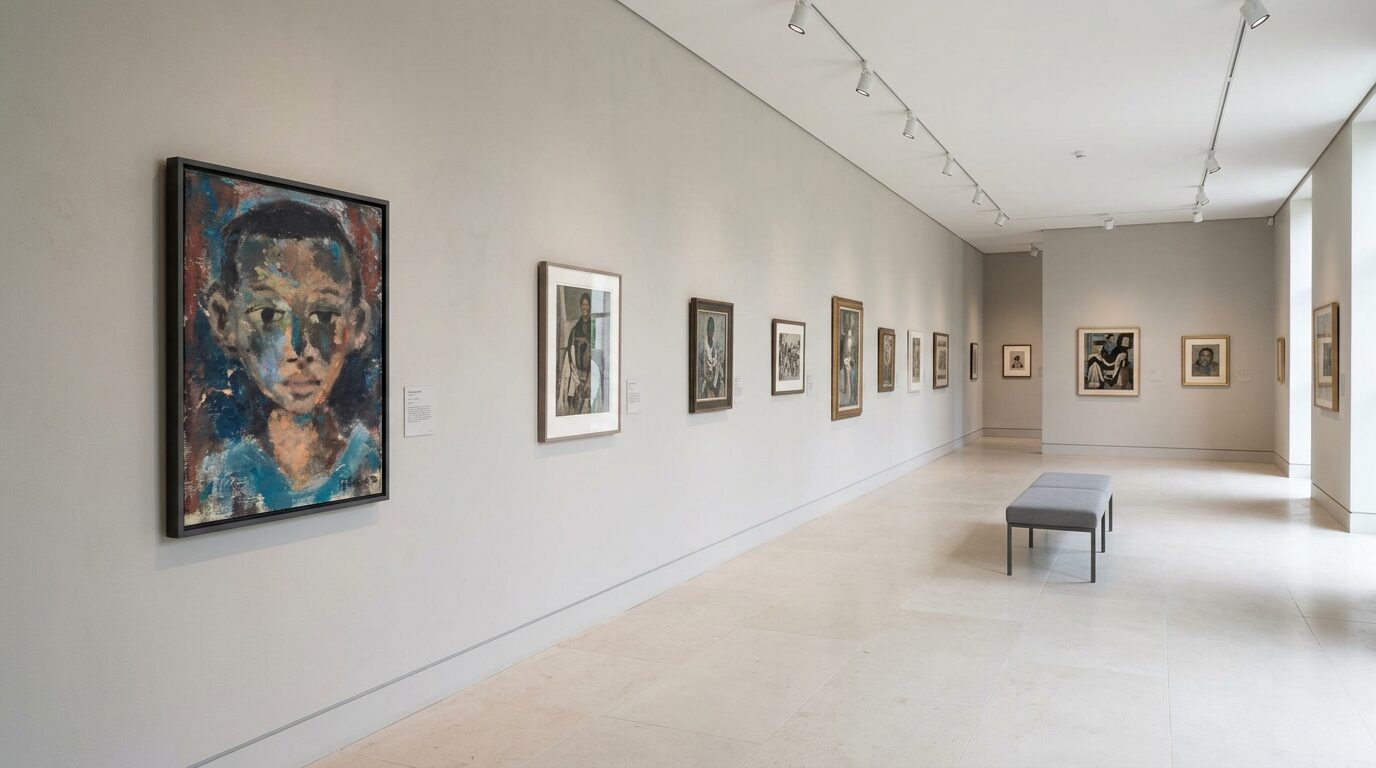
Gerard Sekoto’s paintings tell the stories of people and communities living through a deeply unequal period in South African history. His expressive colour and distinctive compositions draw the eye, but understanding the circumstances behind the work gives it greater depth.
His early paintings captured life in Sophiatown in Johannesburg, District Six in Cape Town and Eastwood in Pretoria. These neighbourhoods shaped his artistic voice, providing subjects through which he recorded everyday life, cultural identity and the pressures of racial discrimination.
For The Gallery at Hayling, this history is an essential part of appreciating his artwork. It matters as much why he painted as what he painted.
The Beginnings of an Artistic Life
Born in 1913 at Botshabelo, near Middelburg in South Africa, Sekoto showed an early interest in drawing. He trained and worked as a teacher before deciding to pursue art professionally.
By the end of the 1930s, he had moved to Johannesburg. Living in Sophiatown brought him into a busy urban environment where the streets, homes and people around him became a source of inspiration.
His growing recognition came at a time when Black South African artists faced considerable barriers. In 1940, the Johannesburg Art Gallery purchased Yellow Houses – A Street in Sophiatown, its first acquisition of a painting by a Black South African artist. It was an important achievement within an art world still shaped by exclusion.
Sophiatown, District Six and Eastwood
The communities Sekoto lived among were central to his work. After Sophiatown, he moved to District Six in Cape Town in 1942, then to Eastwood in Pretoria in 1945. These years produced paintings that remain important records of South African urban life.
His subjects included workers, families, neighbours and children. Streets and domestic settings provided the backdrop to lives shaped by poverty, restricted opportunities and racial oppression. Yet his paintings also conveyed the vitality of these places: people gathering, working and maintaining relationships despite difficult circumstances.
The neighbourhoods were more than settings for his compositions. They were communities he knew through daily experience. His close observation gave the figures within his paintings a sense of individuality and belonging.
Strong colour and expressive arrangements helped communicate this human presence. A familiar street or an ordinary encounter could become a compelling image, drawing attention to people whose lives were too often overlooked.
Why He Painted Matters
Sekoto’s work encourages us to look beyond the surface of a scene. The people he painted lived within a system that limited their freedom and opportunities. Knowing this changes how we understand an image of labour, a family group or a neighbourhood street.
His paintings can be appreciated for their colour, rhythm and composition while also being understood within this wider social history. They preserve the presence of people living through injustice, without reducing their lives to hardship alone.
Song of the Pick, painted in 1946–47, offers a particularly clear example. Its labouring figures convey physical effort and collective strength. In his own explanation of the work, Sekoto described the workers’ rhythm as overpowering the authority of their overseer.
This relationship between artistic expression and lived experience is important to the gallery’s interest in Sekoto. His choice of subjects deserves as much attention as the way he painted them.
Leaving South Africa for Paris
In 1947, Sekoto left South Africa and settled in Paris. He sought a wider artistic world and opportunities beyond the racial restrictions he faced at home. His departure is generally described as self-imposed exile, although that decision must be understood against the discrimination and inequality surrounding him.
He left a year before apartheid was formally introduced in 1948. Racial segregation was already established, however, and continued to shape the lives and prospects of Black South Africans.
Paris became his permanent home, and he never returned to South Africa. That separation gives another dimension to his later paintings. The country he had left remained an important source of subject matter, with memories of its people and places continuing to inform his work.
Life and Work in Exile
Moving to Paris did not bring an easy life. Sekoto faced financial difficulties and the challenges of establishing himself in an unfamiliar country. A talented musician as well as a painter, he worked as a pianist to help support himself.
He continued to paint and draw, responding to new surroundings while maintaining his connection with South Africa. His life in France brought fresh experiences, but distance did not remove the importance of the communities he remembered.
A visit to Senegal in 1966 brought him back to the African continent for the First World Festival of Negro Arts in Dakar. He travelled and sketched during his stay, adding further experiences to the subjects explored in his artwork.
His later work therefore reflects several connected worlds: the South Africa of his memories, his life in Paris and his encounters elsewhere.
Preserving Communities Through Art
The historical importance of Sekoto’s early paintings became even greater as the neighbourhoods he depicted were subjected to forced removals under apartheid.
Sophiatown, District Six and Eastwood were profoundly changed by displacement and demolition. His paintings preserve impressions of these communities before their destruction, recording buildings, streets and everyday encounters that might otherwise be harder to imagine.
Their significance lies in the human details as well as the architecture. People talking, children playing and workers going about their day help preserve a sense of how these places were lived in.
Seen in this context, an apparently ordinary scene becomes a record of community and belonging. It reminds us that the history of racial oppression is also the history of individual lives, relationships and places people called home.
Gerard Sekoto’s Lasting Significance
Sekoto gained renewed recognition towards the end of his life. Research by Barbara Lindop helped recover works and document his career, while a retrospective at the Johannesburg Art Gallery and an honorary doctorate from the University of the Witwatersrand recognised his contribution in 1989. He died in France in 1993.
His artwork continues to offer a personal perspective on South African history. Through his subjects, we encounter the pressures of inequality alongside the dignity, energy and cultural life of the communities he knew.
At The Gallery at Hayling, we believe this background belongs alongside an appreciation of the artwork itself. Understanding Sekoto’s history allows us to look more closely, recognise the experiences behind his subjects and appreciate why these paintings continue to matter.