
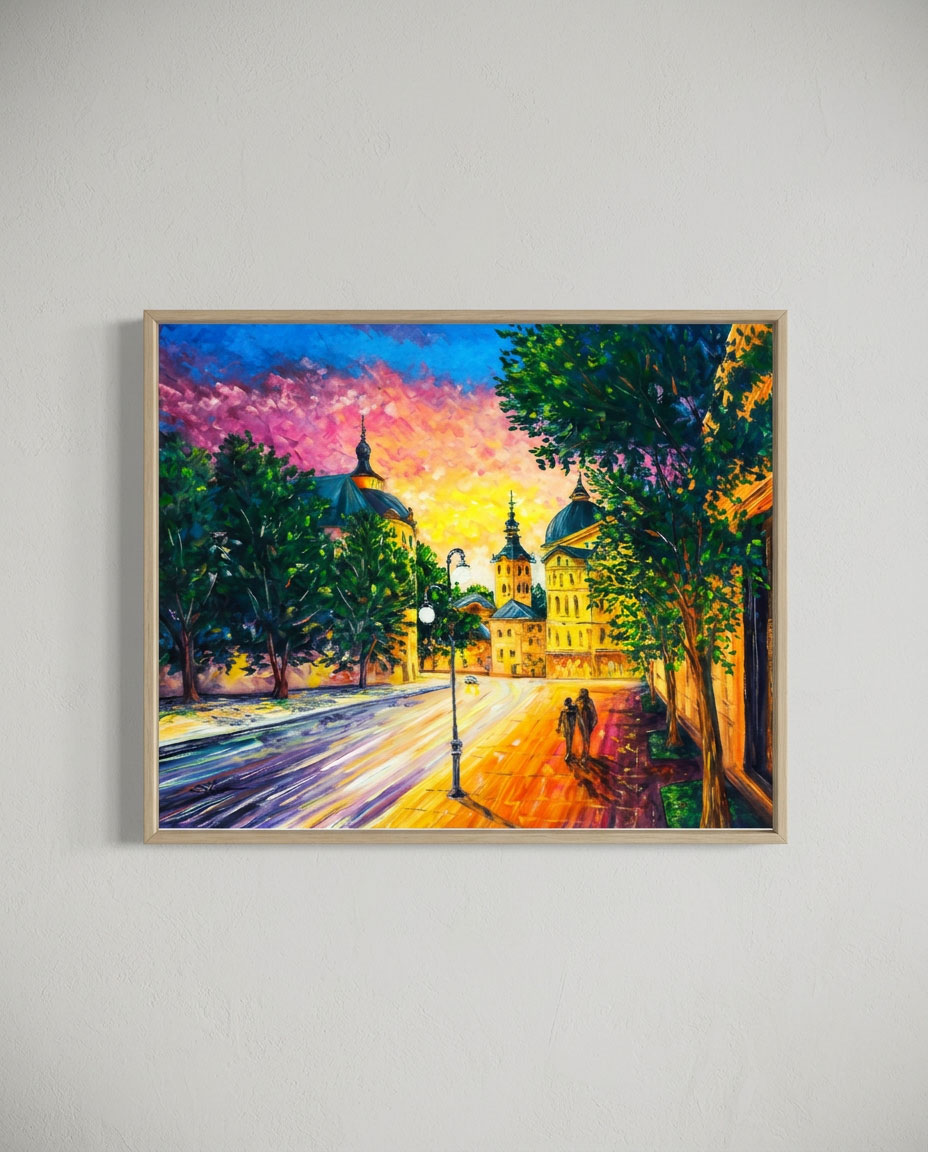
Choosing artwork for your home begins with finding something you enjoy looking at. A painting might remind you of a familiar place, introduce colours you love or hold your attention for reasons you cannot immediately explain. That personal response is a useful starting point.
Practical considerations matter too. The size of an artwork, its position and the light in a room all influence how it looks and how comfortably it sits within your home.
Original paintings and fine art prints offer plenty of possibilities, but you do not need an extensive knowledge of art to make a thoughtful choice. Taking time to understand your preferences and the space available can help you find a piece you will continue to appreciate.
Start with Your Own Taste
Before thinking about matching your furniture, consider the artwork itself. Which subjects attract you? Do you prefer landscapes, portraits, street scenes or abstract compositions? Are you drawn to expressive colour or quieter, more restrained images?
Browsing a variety of artwork can help you recognise patterns in what you like. You might discover that you enjoy a particular artist’s approach, a certain quality of light or paintings that suggest movement.
Try to look beyond what is currently fashionable. An artwork will become part of your daily surroundings, so your own response deserves more weight than a passing interior trend.
It is also worth allowing yourself time. If a piece stays in your mind after you have seen it, think about what made it memorable. That can tell you more than an immediate decision based purely on colour or size.
Consider Where the Artwork Will Hang
You do not always need a location in mind before buying art, but understanding the available space makes the decision easier.
Think about how you use the room and where you are most likely to see the artwork. A painting opposite a favourite chair offers a different experience to one in a hallway that you pass several times a day.
Consider the surrounding features too. Windows, doorways, shelving and furniture affect the amount of clear wall space available. A piece needs enough room to be appreciated without feeling squeezed between other objects.
The atmosphere of the room may also influence your choice. You might enjoy an energetic composition in a social space and prefer something more reflective in a bedroom. These are personal decisions, rather than rules that every home needs to follow.
Choose a Size That Suits the Space
Scale can be difficult to judge when viewing artwork online. Check the dimensions carefully and establish whether they refer to the artwork alone or include its frame.
A useful approach is to mark the proposed dimensions on your wall using paper templates. This helps you understand how much space the piece will occupy and how it relates to nearby furniture.
For artwork above a sofa, sideboard or fireplace, consider the balance between the width of the piece and the object beneath it. A small painting can appear isolated on a large wall, while an oversized work may feel crowded if there is little space around it.
Smaller artwork can be particularly effective in intimate settings where you can approach it closely. It can also work as part of a considered grouping. A large painting creates a different relationship with the room, often becoming a prominent feature.
Neither approach is inherently better. The aim is to choose a scale that allows the artwork to feel comfortable in its setting.
Think About Colour Without Matching Everything
Colour can help connect an artwork with its surroundings, but an exact match is rarely necessary.
A painting might pick up a small detail already present in the room, such as a tone in a rug or an upholstered chair. Equally, contrasting colours can give a space a welcome point of interest.
Look at the overall character of the work. Does it feel warm, cool, lively or subdued? Consider how that quality relates to the room and how you want the space to feel.
Avoid judging a painting solely by a small colour sample on a screen. Where possible, view the artwork in person to get a clearer sense of its tones, surface and detail.
A piece you love may also influence future choices for the room. Artwork can be the starting point for an interior, rather than the final accessory added once everything else is finished.
Original Paintings or Fine Art Prints
Both original paintings and fine art prints can bring individuality to a home. Understanding what you are looking at helps you choose with confidence.
An original painting is a unique work, with a surface shaped by the artist’s materials and technique. Brushwork, texture and layers of colour can contribute as much to its appeal as the subject itself.
Fine art prints offer another way to enjoy an artist’s work. However, the term covers different processes. An original lithograph created as a print is different from a giclée reproduction of an existing painting. Ask the gallery to explain the medium, edition details and any accompanying documentation.
Your decision may depend on your preferences, budget and interest in a particular artist. Take time to understand the individual piece rather than assuming that every print or painting has the same characteristics.
Consider the Frame and Presentation
A frame affects how an artwork relates to the room around it. Its width, colour and finish can change the overall impression of a piece.
When browsing framed artwork, look at the complete presentation as well as the image. Check the outside dimensions and ask whether the frame is included in the price.
An existing frame may suit the work well even if it differs from other finishes in your home. There is no need for every frame in a room to be identical.
If you are considering reframing, discuss the options before making changes. The artwork’s medium, condition and existing presentation should inform the approach, particularly with older or more delicate pieces.
Set a Budget You Feel Comfortable With
Having a budget helps you browse with purpose. Remember to account for any additional costs, including framing, delivery and installation where needed.
Prices can vary considerably according to the artist, medium, size, condition and history of a work. Ask questions about the piece and what is included, especially if you are buying original artwork for the first time.
Try to keep the decision focused on your enjoyment of the artwork. A purchase for your home should feel comfortable, both personally and financially.
You may find the right piece quickly, or you may prefer to build a collection gradually. Leaving a wall empty for a little longer is reasonable if you have not yet found something you want to live with.
Give Yourself Time to Look
Seeing artwork in person can bring together the decisions that are harder to make online. You can assess its scale, notice surface details and spend time with the composition.
At The Gallery at Hayling, we value giving visitors the space to look and ask questions. Understanding the artist, materials and background of a work can add to your appreciation, but your personal connection remains important.
The most satisfying choice is often a piece that continues to interest you after the first impression. It might reveal new details over time, recall a meaningful experience or simply make you glad you chose it whenever you enter the room.